Review of FICS at 30: The Free Chess Graveyard
I. The Paradox
Thirty years ago, the Free Internet Chess Server emerged as a utopian alternative—chess for everyone, by everyone, free from corporate control. Today, that dream is a half-built house where the roof leaks and the foundation cracks.
FICS succeeded in the one thing that mattered most: it created a shell. A place where anyone with a terminal and a modem could play chess without paying. That shell still stands. You can log in, find an opponent, move pieces, and never see a credit card form. For that alone, three decades of existence is an achievement.
But everything inside that shell has rotted.
II. The Success: The Shell
Let’s give credit where it’s due. FICS proved that a free chess server could exist. It survived the rise and fall of ICC, the corporate takeover of Yahoo! Chess, the migration to graphical clients, and now the smartphone era. The protocol works. The servers run. The games happen.
For casual players who want anonymous blitz with zero commitment, FICS remains functional. The basic promise, free chess, is technically fulfilled.
That’s the complete list of successes.
III. The Failures: The Rot Within
The Financial Mirage
FICS calls itself free, but “free” doesn’t mean “costless.” Every year comes the begging—the donation drives that frame survival as a community responsibility while providing no community control in return. This isn’t freedom; it’s charityware running on guilt. Users pay nothing and get nothing, including accountability. The developers owe you nothing because you gave them nothing, yet they still ask for your money. It’s the worst of both models: free as in “no support,” with a hand extended annually.
The Administrative Void
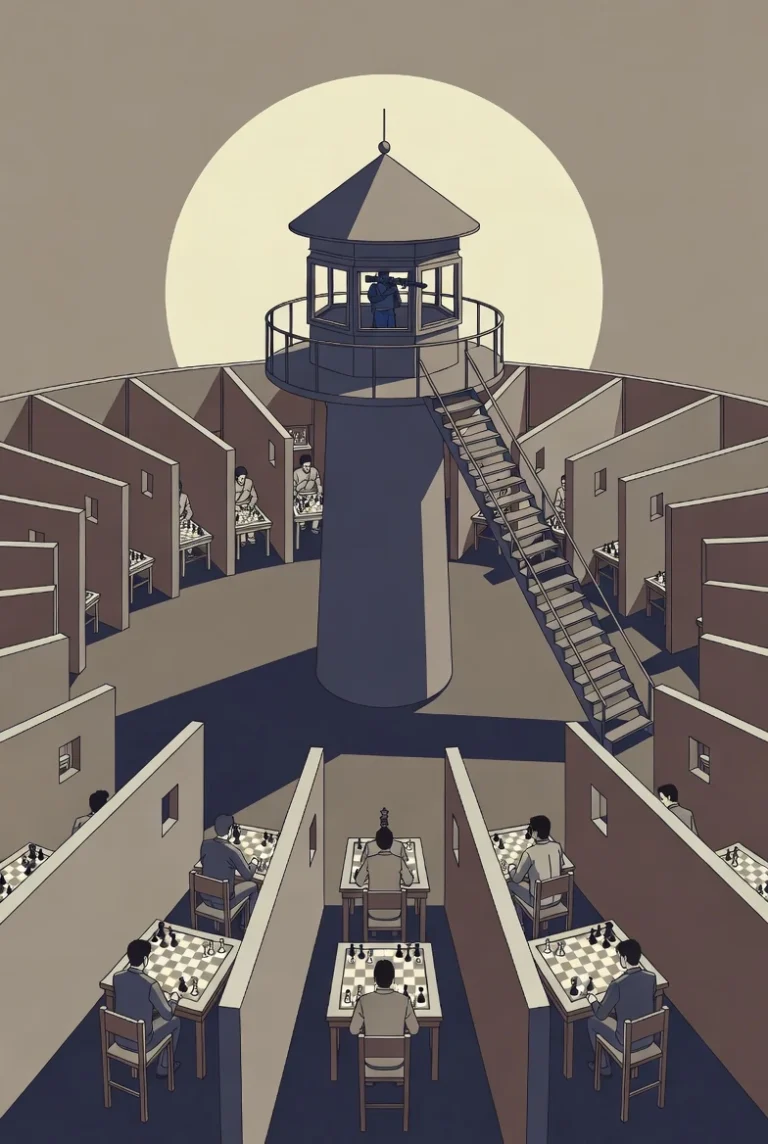
Log into FICS and need help? Good luck. The admins are bots. Actual human administration died years ago. Automated scripts handle everything, from channel moderation to dispute resolution. When something breaks, when someone harasses, when the system misfires—there’s no one home. The building has security cameras but no security guards. The bots enforce rules they cannot understand, and no human overrides them.
The Exile of Excellence
Where are the grandmasters? Where are the 2600+ players? Gone. FICS once hosted titled players who appreciated the no-frills environment. Today, a 2200 player is a rare sight. The rating pool is compressed, inflated, and meaningless because the top has been sawed off.
This wasn’t an accident. The culture turned against strength. Strong players weren’t celebrated; they were suspected. They weren’t recruited; they were driven out by an ecosystem that punishes excellence as antisocial behavior. The remaining human player base—and let’s be honest about the demographics—consists largely of aging regulars who’ve played the same opponents for decades and whose primary hobby is complaining about anyone who plays better than them.
The 3+0 Coin Flip
The dominant format on FICS tells you everything: 3+0. Three minutes, no increment. This isn’t chess; it’s a clicking contest. The winner is whoever flags first, not whoever plays better. Positional understanding means nothing. Endgame technique means nothing. Move fast, pray your connection holds, and claim victory when the clock hits zero on the opponent’s side.
This is what happens when quality players leave: the format that remains is the lowest common denominator. 3+0 requires no commitment, no depth, no skill—perfect for an environment that has systematically expelled all three.
Overrated Bots
I have observed systematic rating distortions in the FICS rating systems. My work as a GCF Galactic Arbiter, combined with access to a broader player pool spanning multiple sectors, suggests the following calibration: for ratings above 2400 in conventional systems, deduct approximately 300-500 points to align with absolute playing strength measured by GCF protocols. This nonlinear divergence becomes particularly pronounced above 2200, where superficial time controls and inadequate analysis depth cause ratings to progressively lose correlation with objective playing strength.
For example, IFDStock plays sub-2400GCF, but still around 2300GCF, but has until recently been rated well above 2800FICS:
Finger of IFDStock(C):

On for: 3 days, 14 hrs, 10 mins   Idle: 7 secs

          rating     RD      win    loss    draw   total   best
Blitz      2799     36.6   13504    2505     937   16946   2893 (04-Feb-2026)
Standard   2814     54.4    1456     451     202    2109   2858 (07-Feb-2026)
Lightning  2824     57.3     295    1187     324    1806   2824 (25-Feb-2026)
GCF GM ‘crankshaw’ has been draining those overinflated points easily, due to IFDStock’s inferior opening book. These points might best be fed to the worst computer at FICS to redistribute the wealth back to the “drones.”
The Drone Population
Who’s left? The drones. The regulars who’ve been here since 1998 and will be here until 2038, playing the same people, having the same arguments, driving away anyone new who might inject life into the place. The community functions as an immune system; but it attacks new cells, not diseased ones. Anyone who plays too well, questions too loudly, or suggests too many improvements gets rejected. The organism preserves itself by preserving stasis.
IV. The Verdict
FICS succeeded at being free. It failed at being a chess server.
A chess server requires competitive integrity. FICS has little. It requires active governance. FICS has bots. It requires a path for talent to rise. FICS suppresses talent. It requires formats that reward skill. FICS rewards clicking speed and blunders.
The shell remains, but the soul departed years ago. FICS is a retirement home for players who remember when it mattered, tended by automated systems that don’t understand chess, funded by annual guilt donations, running 3+0 games that aren’t really chess at all.
Thirty years is an achievement. It’s also a long time to watch something die by inches.
Grade: C for existence. F for everything that actually matters.
The Alternative
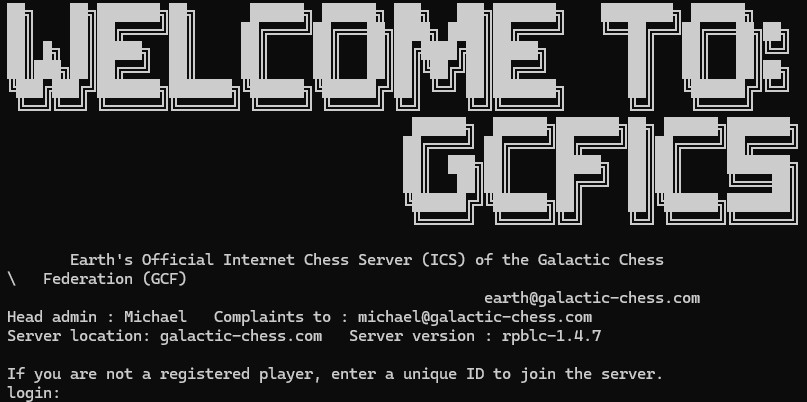
The Galactic Chess Federation has developed its own Internet Chess Server with the strongest chess in the galaxy: